
- Affiliates
- What makes this program worth your traffic
- Commission models and what they actually pay
- CPA versus revshare: the actual math
- Getting set up, from application to first payout
- Payment methods and what to expect
- The marketing kit, and what’s actually useful in it
- Who gets approved, and who doesn’t
- Where affiliates actually lose money without noticing
- A quick gut check before you commit to a model
- Getting started
Affiliates
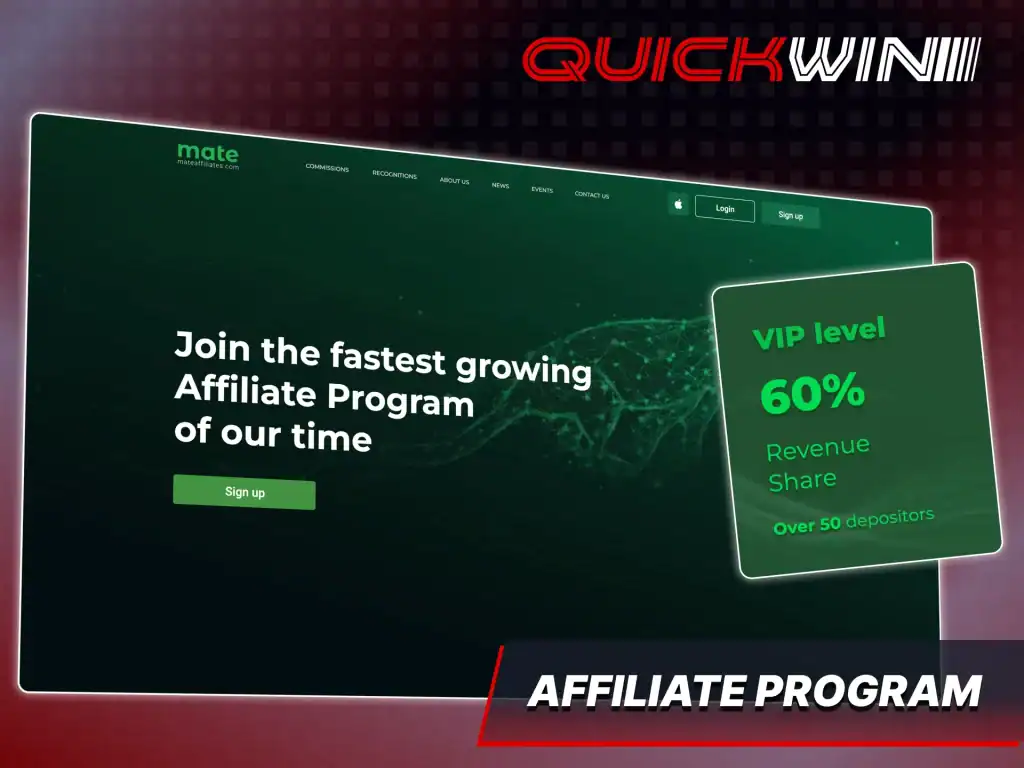
Running an affiliate program well is mostly about not lying to the people you’re working with. Pay on time, track clicks properly, and don’t quietly change terms after someone’s already built a content strategy around your brand. That’s the standard QuickWin holds itself to, and it’s why the affiliate side of this casino has grown mostly through word of mouth rather than aggressive recruiting.
If you’re weighing whether to add QuickWin to your portfolio of casino offers, or you’re just starting out and trying to figure out which programs are worth your time, this page covers the real mechanics: what you get paid, how tracking actually works, what kind of traffic gets approved, and where affiliates tend to leave money on the table without realizing it.
What makes this program worth your traffic
Most gambling affiliate programs look identical on paper. Percentages, tiers, a dashboard screenshot on the landing page. The differences show up once you’re actually inside the program, dealing with a slow-to-respond manager or a commission report that doesn’t match your own click tracking.
QuickWin’s conversion rate on Canadian traffic tends to run higher than average for the vertical, largely because the sign-up flow doesn’t punish users for being Canadian. Interac works instantly. KYC verification, when it’s triggered at all, usually clears within an hour rather than the two or three business days some competitors still take. None of that is something you control as an affiliate, but it directly affects how many of your clicks turn into deposits, so it’s worth mentioning rather than pretending the casino’s own UX doesn’t matter.
The other piece is accountability on the affiliate side specifically. Every partner gets assigned a named affiliate manager, not a shared support inbox. If a campaign underperforms, you can actually ask why and get a real answer, sometimes with suggestions about which promotions are converting for other partners running similar traffic that month.
Commission models and what they actually pay
QuickWin runs three payment structures. You pick one at sign-up, though switching later is possible if your traffic mix changes.
| Model | Payment structure | Rate range | Suits |
|---|---|---|---|
| Revenue share | Ongoing percentage of net gaming revenue from each referred player, paid monthly for the lifetime of that player’s activity | 25% to 45%, scaling with monthly first-time depositor count | Content sites, review blogs, long-term SEO projects |
| CPA | One flat payment per qualified first-time depositor, no ongoing share | $50 to $150 CAD, depending on deposit size and player geo | Paid ads, influencer shoutouts, anyone who needs cash flow now rather than later |
| Hybrid | Smaller CPA payment upfront plus a reduced ongoing revshare | $25 to $60 CAD plus 15% to 25% revshare | Affiliates who want some early return without giving up the long tail entirely |
A detail that catches new affiliates off guard: revenue share is calculated on net gaming revenue, meaning deposits minus payouts minus processing costs, not gross deposits. A player who deposits $500 and cashes out $480 the same week generates almost nothing in commission, even though the deposit number looks great in your dashboard. This is standard across the industry, not a QuickWin quirk, but it explains why your revshare earnings can feel disconnected from raw deposit volume some months.
Tiers reset and recalculate on the first of each month based on how many new depositing players you referred in the previous 30 days. Ten to twenty-nine new depositors typically lands you around 30%, thirty to fifty-nine pushes you toward 35%, and consistent volume above sixty new depositors a month puts most affiliates at the top bracket. There’s no clawback if a slow month follows a strong one. Your rate simply adjusts for the following month, and nothing you’ve already earned gets touched.
CPA versus revshare: the actual math
A lot of affiliate guides tell you to just pick revshare because “it pays forever,” which is true but incomplete advice. If your traffic converts casual, low-deposit players who churn within a few weeks, a flat $80 to $100 CPA payment will almost always beat what you’d earn from revshare on the same player. Revshare only pulls ahead when your referred players stick around and deposit regularly over months, which tends to describe organic search traffic and returning readers far more than one-off paid clicks. If you genuinely don’t know which category your traffic falls into yet, the hybrid model is the sensible default until you have three or four months of data to compare.
Getting set up, from application to first payout
- Submit your application through the affiliate portal, including your site or channel URL, an honest estimate of monthly traffic, and where that traffic comes from. Applications go through manual review, not automatic approval, and most decisions come back within one to two business days.
- Set your commission model once approved. You’ll get access to your unique tracking ID and a set of links tied to specific pages, promotions, or games rather than just a generic homepage redirect.
- Build your tracking links properly. Deep links to specific promotions convert noticeably better than a single homepage link stuffed into every article. If you’re writing about a particular slot title or a deposit bonus, link straight to that page.
- Publish and monitor. Once your content or campaign is live, check the dashboard within the first few days, not weeks later. Early click-to-registration ratios tell you quickly whether a placement is working or needs to move.
- Get paid on the monthly cycle. Commissions lock in by the 5th of each month covering the prior month’s activity, and payment goes out shortly after, assuming you’ve cleared the minimum threshold for your chosen method.
Payment methods and what to expect
| Method | Minimum payout | Processing time | Worth knowing |
|---|---|---|---|
| Interac e-Transfer | $100 CAD | 1 to 2 business days | The default choice for most Canadian affiliates, no real downside |
| Cryptocurrency (BTC, USDT) | $50 CAD equivalent | Under 24 hours | Lowest threshold and fastest turnaround, useful when you’re just starting out |
| Bank wire | $500 CAD | 3 to 5 business days | Makes sense once your monthly earnings are consistently high, otherwise the higher minimum just delays your first payout |
| Skrill or Neteller | $100 CAD | 1 to 3 business days | Common among affiliates running traffic across multiple countries, not just Canada |
One thing worth flagging for anyone new to affiliate marketing generally: CPA and revshare payments count as business income in Canada, and depending on your total earnings you may need to register for a GST/HST number or at minimum track this properly for tax season. QuickWin doesn’t withhold anything automatically, so that responsibility sits with you.
The marketing kit, and what’s actually useful in it
Most affiliate programs hand you a folder of banners from 2019 and call it a marketing kit. QuickWin refreshes creative assets on a rolling basis, tied to whatever promotions are currently live, which matters more than it sounds like it should. A banner promoting an expired bonus doesn’t just look sloppy, it actively hurts your conversion rate because visitors click through expecting an offer that no longer exists.
What you’ll find in the partner area:
- Responsive banners in the standard IAB sizes, built to hold up on both desktop sidebars and mobile inline placements
- Pre-built landing pages tied to specific promotions, so you’re not sending traffic to a generic homepage and hoping the offer is still visible
- Seasonal creative tied to Canadian sporting calendars, particularly NHL playoffs and the Grey Cup window, since traffic spikes noticeably around both
- Deep links into specific game categories, useful if your content is built around slot reviews or a particular provider like Pragmatic Play
- A monthly notes brief from the affiliate team flagging which games and offers are converting best, which is more useful for content planning than most affiliates realize until they start using it
Who gets approved, and who doesn’t
Approval isn’t really about audience size. A niche blog with two thousand monthly visitors who are genuinely interested in online casino content will get approved faster than a generic traffic farm with a hundred thousand irrelevant clicks. What matters is relevance and how the traffic was acquired.
Sites and channels that typically get approved without issue include casino comparison and review blogs, YouTube or Twitch channels covering gameplay or bankroll strategy, SEO content sites built around gambling topics, opted-in email lists with genuine subscribers, and paid traffic buyers running campaigns through platforms that permit gambling ads, such as certain native ad networks or compliant search campaigns.
What doesn’t get approved, and this list matters just as much: adult content sites of any kind, traffic that specifically targets or fails to exclude self-excluded users, incentivized sign-up traffic where users are paid or rewarded just to register, and anything using misleading claims about guaranteed wins or “risk-free” gambling. These aren’t arbitrary restrictions. Canadian gambling advertising standards, particularly around responsible gambling messaging, are enforced fairly strictly, and QuickWin would rather lose a marginal traffic source than risk its licensing over an affiliate’s messaging.
Where affiliates actually lose money without noticing
A few patterns show up repeatedly among underperforming affiliates, and none of them are complicated to fix once you know to look for them.
Homepage-only linking is the biggest one. An affiliate writes a detailed post comparing welcome bonuses, then links every mention of QuickWin to the generic homepage instead of the actual bonus page being discussed. The visitor lands somewhere that doesn’t match what they just read, hesitates, and a percentage of them simply leave. Deep linking to the specific page you’re describing closes that gap immediately.
Stale creative is the second. Banners promoting an offer that ended two months ago don’t just underperform, they can actively damage trust with returning readers who notice the mismatch. Checking your placements against the current promotions page every few weeks takes ten minutes and prevents this entirely.
The third is treating the dashboard as a monthly chore instead of a weekly habit. Affiliates who check performance weekly catch a dead link or an underperforming placement within days. Affiliates who check monthly lose three or four weeks of traffic to a problem that could’ve been fixed on day two.
A quick gut check before you commit to a model
If you’re still unsure whether CPA, revshare, or hybrid fits your traffic, ask yourself honestly whether the people clicking your links are already interested in gambling specifically, or whether they’re a broader audience that happens to see your content. Pre-qualified, intentional traffic tends to reward revshare over time. Broader or colder traffic, including most paid campaigns, usually performs better under CPA, where you’re not depending on player retention you can’t control or predict.
Getting started
Applying takes about five minutes through the affiliate portal, and most partners hear back within two business days. Bring a real traffic estimate rather than an optimistic one, since it helps your affiliate manager set you up on the right commission model from the start instead of switching things later. If you’re running meaningful paid volume or managing several properties at once, it’s also worth asking directly about custom terms during onboarding rather than waiting until you’ve proven volume first. Most of these conversations are more flexible than the published rate card suggests.

Bonus Roundup October 2026